
Siding rarely fails all at once. It gives you a long warning, usually several years of it, and most homeowners walk past the signs every day without reading them. The good news is that you do not need any tools to do a decent inspection. You need an hour, a dry afternoon, and a willingness to look closely at walls you normally ignore.
Start at one corner and walk the whole house slowly. Look at the wall from ten feet back, then step in and look from two feet. Different problems show up at different distances.
1. Paint that will not stay on
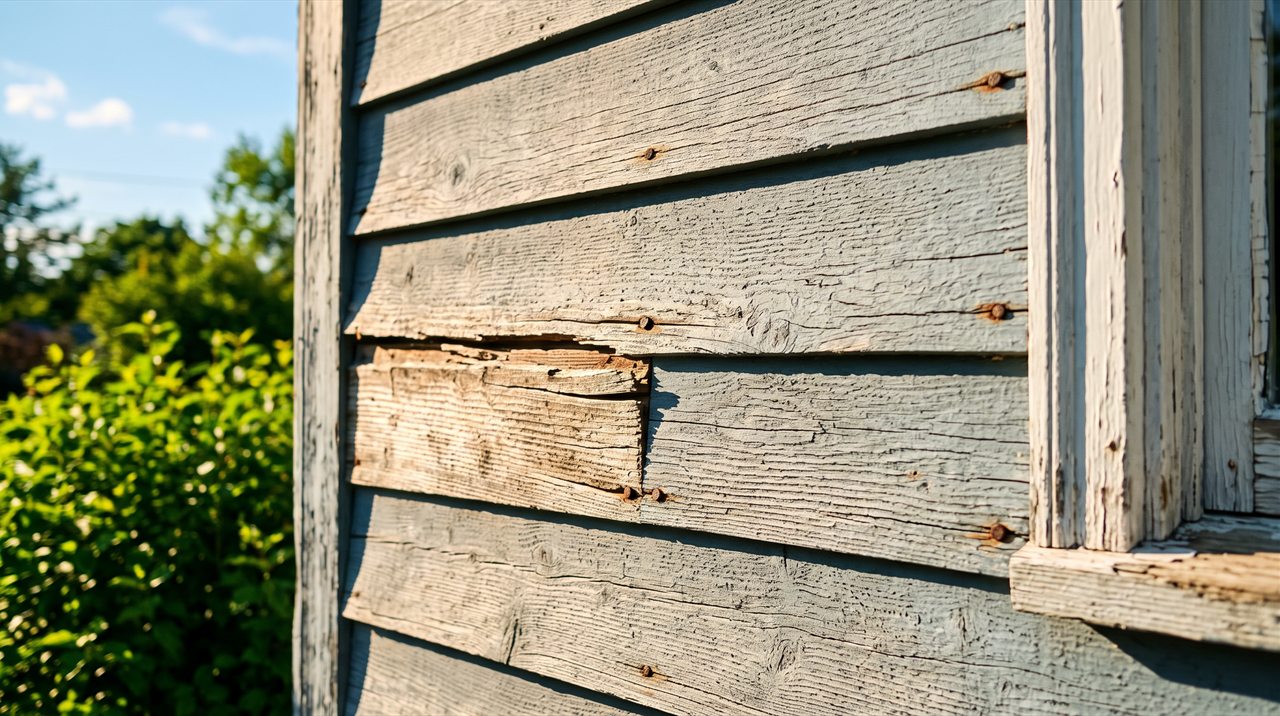
If you are repainting every three or four years and the new coat is already flaking, the problem is usually not the paint. It is moisture moving through the wall from behind and pushing the coating off. Paint sticks to dry wood. It cannot stick to wood that keeps getting wet.
2. Boards that feel soft
Press your thumb firmly against the siding, especially low on the wall, under windows, and near downspouts. Sound siding pushes back. Failing siding gives, feels spongy, or dents. If your thumb sinks in, the board is already gone and the sheathing behind it may be too.
3. Swelling, cupping, or curling edges
Look down the length of a wall with your eye close to the surface. The lines should be straight and the shadows even. Boards that bulge in the middle, curl at the bottom edge, or pull away from the wall have absorbed water and lost their shape. They will not go back.
4. Cracks and splits
A single crack from a thrown rock is a repair. Cracks running with the grain on many boards, especially near nail lines, mean the material is fatigued or was nailed too tight. Vertical splits at the ends of boards usually mean water got into the cut end and froze.
5. Gaps at the seams and corners
Every joint moves a little with temperature. What you do not want is a gap you can slide a credit card into, caulk that has pulled away in long strings, or a corner board with daylight behind it. Those are open doors. Water does not need much of one.
6. Moss, algae, and dark streaks that come back
A green film on a shaded north wall is normal here and washes off. What matters is how fast it returns. If you clean a wall and it is dark again in six months, that wall is staying wet, and staying wet is what kills siding, paint, and eventually framing.
7. Stains below windows and at joints
Look for dark vertical streaks running down from the bottom corners of windows. That pattern almost always means the flashing above or beside the window is failing and water is running behind the siding instead of over it. This one is worth acting on quickly, because the damage is happening where you cannot see it.
8. Rising heating bills with no other explanation
Siding itself is not your main insulation, but siding that has let water into the wall cavity is. Wet insulation stops working. If your bills climbed over two or three winters and nothing else changed, walk the outside of the house and look for the wet wall.
9. Signs on the inside
Bubbling or peeling paint on an interior wall, a musty smell in one room, or wallpaper lifting at a seam can all be the inside face of an outside problem. Check the exterior wall on the other side of that room.
10. Age plus material
If your siding is hardboard from the 1980s or early 1990s, it is at or past the end of its life even if it looks acceptable. That product absorbs water at the edges and swells. Aluminum from the 1970s is often still watertight but chalky and dented. Original cedar that has been painted many times may have another decade in it if the finish has been kept up.
Which of these are urgent
Not everything on that list means an emergency. Here is how we sort it.
Call this month: soft or spongy boards, stains running from window corners, visible gaps at flashing or corners, any interior sign of moisture, or wasp and carpenter ant activity at a wall. Those all point to water already inside the assembly, and the cost of waiting is measured in framing, not in siding.
Plan within a year: paint that will not hold, widespread cupping or curling, many cracked boards, or hardboard siding of a certain age. The house is not in danger this week, but you are paying for repairs you will throw away when you replace the wall.
Watch and maintain: surface moss, chalky but sound aluminum, faded color, a handful of cracked boards in an otherwise healthy wall. Clean it, touch up the finish, and check again next year.
The test that settles it
When we are not sure from the outside, we pull one board in the worst looking spot and look at the sheathing behind it. That single hole tells you more than an hour of speculation. If the sheathing is dry and the weather barrier is intact, you probably have a siding problem you can repair. If the sheathing is dark, soft, or crumbling, you have a wall problem, and patching the outside will only hide it.
It takes about fifteen minutes and it is the honest way to answer the question. If you want a second set of eyes on a wall that is bothering you, book a free walkthrough. We will tell you plainly whether you are looking at a repair, a wall, or a whole house, and we will show you the photos either way.