
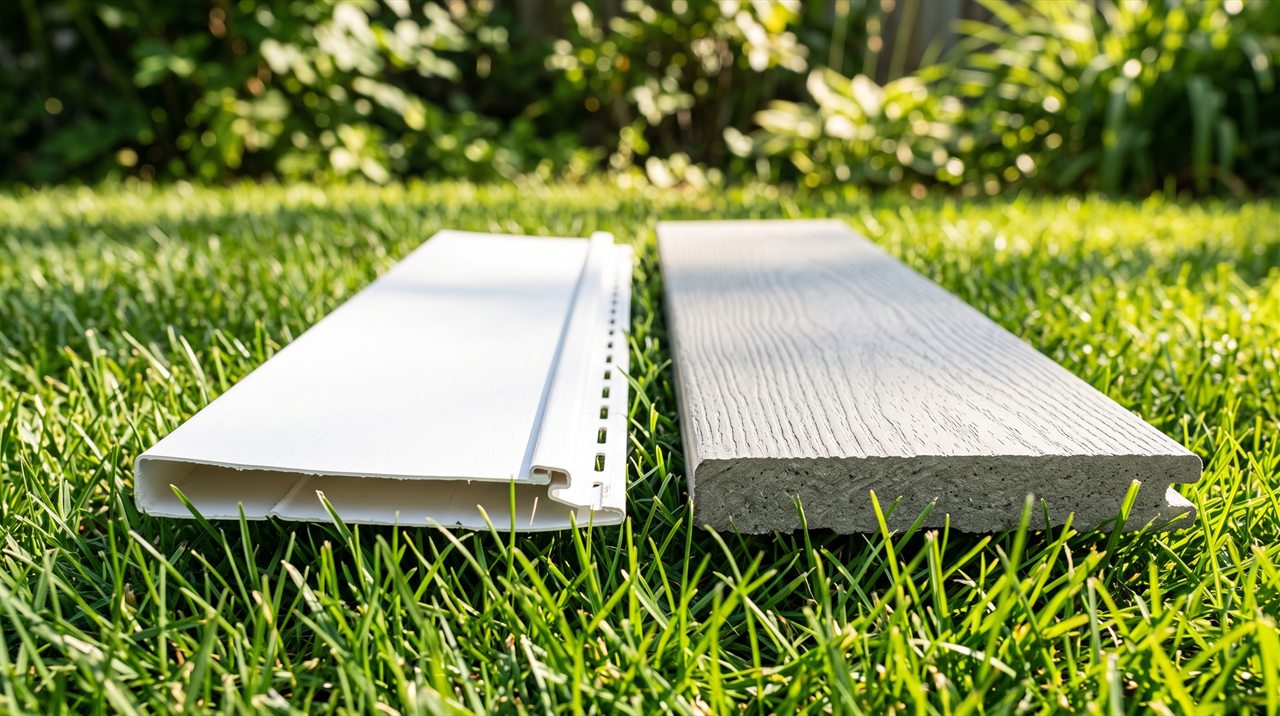
These two account for most of the siding going on houses in this country, and they are about as different as two products in the same category can be. One is a thin plastic panel that hangs loose on the wall. The other is a dense cement board that gets nailed tight. Understanding how differently they work explains almost every other difference between them.
What they are made of
Vinyl siding is polyvinyl chloride, the same family of plastic as pipe, formed into panels with the color mixed through the material. Because the color goes all the way through, a scratch does not show a different shade underneath.
Fiber cement is portland cement, sand, and cellulose fiber pressed into boards and cured. It is essentially a thin, flexible piece of concrete with wood fiber in it for strength. The color is either a factory applied coating or paint you apply on site.
Price
Vinyl runs about 7 to 12 dollars per square foot installed. Fiber cement runs about 12 to 20. On a house with 2,400 square feet of wall, that is roughly a 12,000 dollar gap at the middle of each range.
The gap is mostly labor. Fiber cement is heavy, around two and a half pounds per square foot compared to under half a pound for vinyl. Heavy means two people on every board, more staging, and slower progress. Cutting it requires specific blades and dust control. A crew that hangs 700 square feet of vinyl in a day might do 300 of fiber cement.
How they handle water
This is the difference people misunderstand most. Neither product is waterproof, and neither is supposed to be. Both are rain screens. Water gets behind both of them, and the weather barrier underneath is what actually protects your house.
Vinyl handles this by hanging loose. Panels lock together and float on the nails so they can expand and contract, and there are weep holes at the bottom of each course to let water out. It sheds and drains well by design.
Fiber cement is fastened tight and depends on lapping and flashing to move water down and out. Done right it is excellent. Done wrong, water sits at butt joints and at the bottom edge instead of draining. The product does not rot, but the sheathing behind it certainly does.
In practice, in a wet climate, both work if the flashing and the barrier behind them are right. Vinyl is more forgiving of a mediocre install. Fiber cement rewards a good one.
Fire
Fiber cement does not burn. It carries a Class A rating and is often required or discounted by insurers in wildfire zones. It also will not melt from a barbecue too close to the wall or from sunlight reflecting off a neighbor's window.
Vinyl melts. It will deform from a grill on a deck, from a fire pit, and occasionally from concentrated reflection off low emissivity glass next door. It is not a house fire hazard in normal use, but it is a real limitation.
Impact and weather
Fiber cement is far tougher. Hail, a thrown ball, a ladder foot, a lawnmower rock: it shrugs most of that off. It also handles high wind better because it is nailed tight rather than hung loose.
Vinyl in cold weather is brittle. The same impact that leaves no mark in August can crack a panel in January. Wind can pull a course loose if the nailing was sloppy or the panels were locked too tight.
Color and appearance
Fiber cement takes color better and holds it longer. Factory finishes carry 15 year warranties and generally look good beyond that. Because it can be painted, you can change the color later without replacing anything, which is a real advantage over a 40 year life.
Vinyl cannot be repainted successfully in most cases. The color you choose is the color you have. Dark vinyl fades faster than light vinyl, particularly on sun facing walls. Modern vinyl colors are much better than they used to be, but the darkest shades still show their age first.
Up close, vinyl shows seams where panels overlap, and the corner posts and J channel around windows are recognizable. Fiber cement uses real trim boards and looks closer to painted wood from any distance.
Repairs
Vinyl wins this one, and it is not close. A cracked panel can be unlocked with a simple tool, pulled, and replaced in ten minutes without touching anything above or below it. The catch is matching. Color and profile availability changes over the years, and a panel from a discontinued line will never match exactly.
Fiber cement repairs are more involved. Because boards are nailed and lapped, replacing one in the middle of a wall means carefully freeing the boards above it. It is very doable, but it is an hour instead of ten minutes. The advantage is that you can also simply repaint a damaged area and make it disappear.
Maintenance
Vinyl asks for a wash once a year and nothing else. No paint, ever.
Fiber cement asks for a wash once a year, a check of the caulk at trim joints every few years, and repainting somewhere around year 15 for a factory finish or year 10 to 12 for a field painted wall. That repaint is a real cost that belongs in your comparison.
Resale and insurance
Fiber cement generally returns more at sale and reads as an upgrade to buyers in this region, because it is what quality builders use here. Some insurers offer a small discount for noncombustible siding. Vinyl reads as neutral on a starter home and as a downgrade on a higher end house.
So which one
Choose vinyl if the budget is the binding constraint, you never want to paint anything, you want the easiest possible repairs, or you are preparing a rental or a house you plan to sell within a few years.
Choose James Hardie fiber cement if you are staying in the house, you want the wall to look painted rather than paneled, fire matters where you live, or you want the option to change the color in fifteen years without replacing the siding.
Either one, installed correctly over a proper weather barrier with proper flashing, will keep your house dry for decades. Either one, installed badly, will not. Read more about our James Hardie fiber cement work, read more about vinyl, or book a walkthrough and we will price both on your house.