
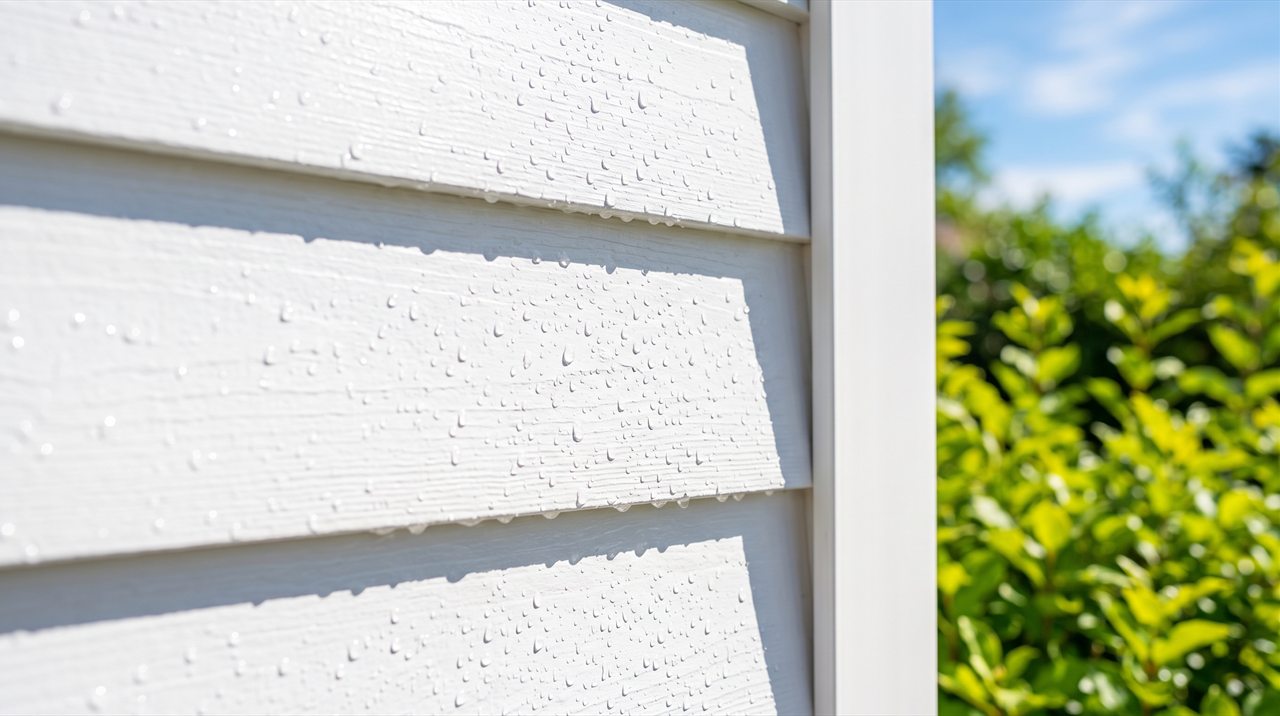
Siding maintenance is the highest return work you can do on a house, and almost nobody does it. One afternoon a year, maybe two hundred dollars in supplies, and you add years to a wall that costs five figures to replace. Here is the whole routine.
Wash the house once a year
In our climate, walls grow things. Algae, moss, mildew, and general grime hold moisture against the surface, and moisture held against a surface is what starts most siding failures. Washing is not about looks. It is about keeping the wall dry between rains.
Late spring is the best time here, after the wet season and before summer. Pick a cloudy day so your cleaner does not dry on the wall before you rinse it.
What you need: a garden hose with a spray nozzle, a soft bristle brush on an extension pole, a bucket, and a cleaner. For most walls, a gallon of water with a cup of oxygen bleach and a squirt of dish soap does the job. For heavy mildew, a mix of one part household bleach to four parts water works, but wet your plants first and rinse them after.
How to do it: work in sections about ten feet wide, from the bottom up. Washing upward keeps the cleaner from running down over dry siding and leaving streaks you cannot get out. Let the cleaner sit a few minutes, brush gently, then rinse from the top down.
About pressure washers
This is where people cause damage. A pressure washer aimed up under a course of siding drives water straight behind the wall and into the sheathing. That is the opposite of what you are trying to do. Many manufacturers will void a warranty over it, and the damage does not show up for two or three years.
If you use one anyway, follow these rules. Keep the pressure under 1,500 psi. Use a wide fan tip, 40 degrees or more. Stay at least three feet back. Keep the spray level or angled slightly down, never upward. Never aim at a seam, a corner, a window, or a vent.
On fiber cement and vinyl, a garden hose and a brush will get you 95 percent of the result with none of the risk. On cedar, skip the pressure washer entirely.
Walk the perimeter twice a year
Spring and fall, take twenty minutes and walk around the house looking at the wall, not through it. You are checking for five things.
Caulk. Look at every joint where siding meets trim, and around windows and doors. Caulk that has pulled away, cracked, or gone hard has stopped doing its job. Cutting out and replacing a bad joint takes ten minutes and a tube of good exterior sealant.
Clearance at the bottom. Siding should stay at least six inches above soil and two inches above a hard surface like a patio or a walk. Mulch and flower beds creep up over the years. Rake them back.
Plants touching the wall. Trim shrubs back at least a foot. Plants hold moisture against siding, block air movement, and give insects a bridge to the house.
Gutters and downspouts. Clean them twice a year. An overflowing gutter is the single most common cause of the rot we open up. Make sure downspouts carry water at least three feet away from the foundation, not against the wall.
Damage. Cracks, holes, loose panels, and woodpecker or wasp activity. Small fixes now, before winter, prevent the wet wall you find in March.
What each material needs specifically
Vinyl: wash yearly, that is genuinely it. Keep grills and fire pits a safe distance from the wall, and be careful with ladders in cold weather. Check that the bottom weep holes are not blocked by paint or debris.
James Hardie fiber cement: wash yearly and inspect the caulk at trim joints every two or three years. Plan to repaint around year 15 if it came with a factory finish, or year 10 to 12 if it was painted on site. Touch up any chips down to the board promptly, because the core will absorb water.
Engineered wood: wash yearly and pay close attention to the bottom edge and to any cut ends around windows. If you see swelling or a fuzzy edge, seal it now. Keep the finish current.
Cedar: wash gently, no pressure. Plan on stain or paint every 5 to 8 years depending on exposure. West and south walls will need it before north walls do, and doing them on different schedules is completely fine.
Metal: wash yearly. Touch up any scratch that goes through the coating, especially on steel, because bare metal in this climate will corrode.
The repaint question
Do not wait for peeling. By the time paint flakes, the surface underneath has already been exposed and the prep work has doubled. The right time to repaint is when the color looks slightly chalky if you rub it with a clean cloth, or when the sheen has gone flat and uneven.
Repainting on schedule costs a fraction of repainting after failure, and it is the single cheapest way to add a decade to a wall.
What to hand off
Anything above one story is worth paying for. Most of the injuries in this trade come from ladders, and the view from a proper ladder is the only way to inspect soffit, fascia, and the flashing where roofs meet walls. Those are also the places where problems start, so they are worth a real look.
Also hand off anything involving flashing, anything where you have found soft wood, and any repair where you cannot match the existing material yourself.
A yearly wash, twice yearly walks, gutters kept clear, and finish kept current. That is the whole program, and it is the difference between replacing your siding at year 20 and replacing it at year 40. If something on your walk looks wrong and you want a second opinion, book a free walkthrough.